
‘AI Could Kill Us All By 2030’ Is A Useful Misdirection

In theatrical magic, a misdirection is a form of deception in which the performer draws audience attention to one thing to distract it from another. Managing audience attention is the foremost requirement of all magic acts, and misdirection is the central secret. The central secret to the AI magic trick is to talk about the purely theoretical as if it’s inevitable and imminent, while moving past the current reality that AI companies are consuming enormous resources and providing very little societal benefit. The misdirection is working. Whistles are blowing, titans of industry and heads of state are summiting, accords are being signed, and the news coverage is constant.
This all started on September 8th, when former Anthropic and OpenAI researcher Jacob Coxon quit his job in protest and tweeted “The people building AI earnestly believe that it could kill us all by the end of the decade” as part of a long thread about how fast AI is moving and how much a slowdown is needed. AI CEOs Sam Altman, Dario Amodei and Elon Musk quickly agreed, saying the pace of development needs to slow and be closely monitored. President Trump held An Important Meeting. The United Nations Security Council was briefed. So, what is it that has everyone so worried?
The near future according to AI leaders
To understand the theory around AI, one has to follow along with the “AI thinkers” in the gross-but-appropriately-named exercise of mental masturbation. To avoid this post reading like an E.L. James novel, let’s call these thinkers AIMMerz (AI Mental Masturbaterz). AIMMerz include AI company leaders and employees, investors, consultants and any other grifters whose business is speaking about the Future Of Tech. They think hard and deep about the future purely to satisfy their big brains (and bank accounts), with no other practical purpose. They really tickle those mind grapes with big ideas about technology, philosophy, economics, geopolitics and God. They are very annoying, and they are running things right now. Unfortunately, we must familiarize ourselves with their language and concepts to follow the story they are selling. So plug your nose if you must (it is quite rank) and join me in the future according to AIMMerz.
Note: AIMMerz debate endlessly on the nuances of definitions and concepts in this theoretical world, that is their wont, but they have all generally coalesced around the ideas outlined below
The levels of AI capability
- Artificial Narrow Intelligence (ANI): as good or better than humans at some narrowly defined tasks (e.g. driving cars, playing chess). This is the current state of AI (more on this later).
- Artificial General Intelligence (AGI): a theoretical form of AI that would have human-level intelligence, learning and reasoning with the ability to make connections across different fields. AGI can also work on longer tasks autonomously, with minimal or no human supervision. Think of it as the ability to have a fully competent virtual employee in any field that never needs to stop working.
- Artificial Superintelligence (ASI): a very theoretical form of AI that would have capability beyond the scope or comprehension of human intelligence. It is a level of intelligence we can’t understand by definition, and it could unlock the secrets of the universe. Human supervision becomes a matter of trusting what ASI tells you, because you can’t understand what it is doing much less keep up with how fast it is doing it. This is the level of AI that threatens to kill us all, according to the AIMMerz.
- Artificial Hyperintelligence (AHI): a very very theoretical form of AI that utilizes time travel loops to rapidly increase the speed of AI research. Just kidding, I made this one up. But is it all that different from Artificial Superintelligence?
The path to superintelligence
Please allow me to repurpose the evergreen South Park startup plan graphic to explain how AIMMerz say we will reach superintelligence (ASI) soon.
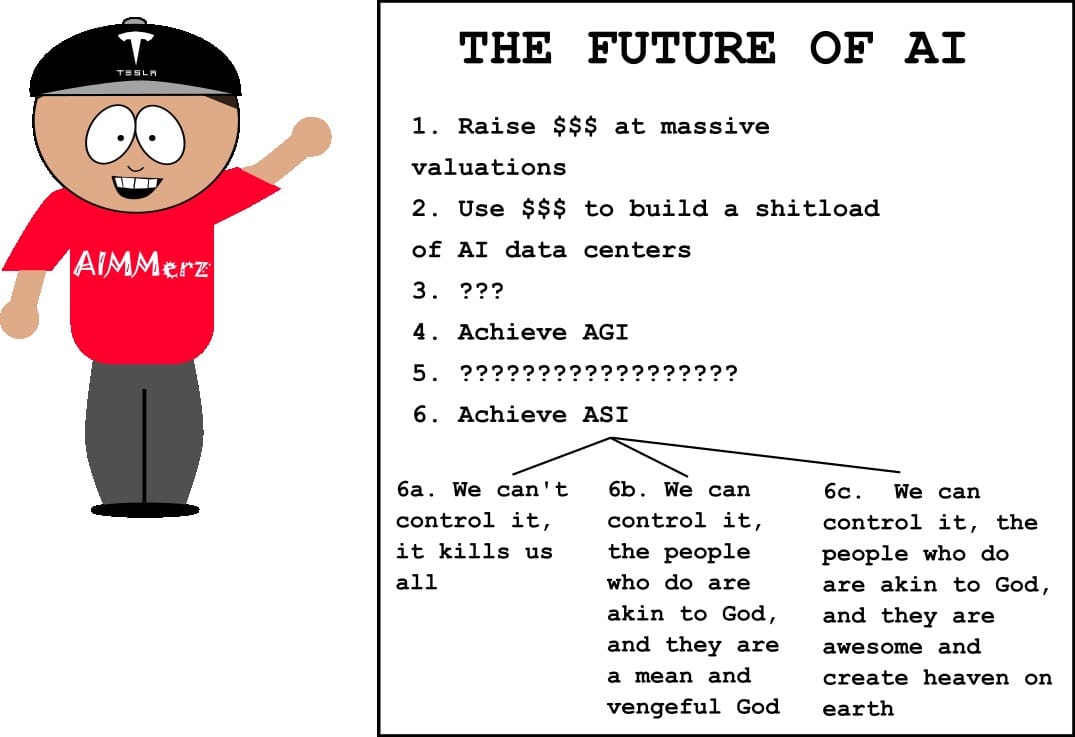
Let’s break this plan down in a bit more detail.
1. Raise $$$ at massive valuations – The value of leading AI companies has exploded. Anthropic was valued at $18 billion less than three years ago. Their latest round of funding has them valued at nearly $1 trillion. OpenAI has seen similar valuation growth over the same period, going from $83 billion to $1.4 trillion. Since February 2024, these two companies have raised $410 billion that we know about. Why do they need more money than the GDP of the Czech Republic?
2. Use $$$ to build a shitload of data centers – Per the MIT Technology Review “Meta and Microsoft are working to fire up new nuclear power plants. OpenAI and President Donald Trump announced the Stargate initiative, which aims to spend $500 billion to build as many as 10 data centers. Apple announced plans to spend $500 billion on manufacturing and data centers in the US over the next four years. Google expects to spend $75 billion on AI infrastructure alone in 2025.”
3-4. ??? > Achieve AGI – The theory goes that ANI begets AGI. So, we create a narrow AI capability that’s really good at speeding up AGI research. With all of this new computing capacity using ANI to perform AGI research we solve it, somehow. By what mechanism this is achieved is a matter of debate among AIMMerz, ranging from enhancing current AI capabilities to reproducing the human brain in digital form.
5-6. ??????????????? > Achieve ASI – The theory continues that AGI begets ASI. The specifics here are even less defined, but the idea is once we have AGI up and running it will able to research AI at or beyond human capability, and it also works much faster. So research that would take humans a year to complete takes AGI a week. Eventually we can’t keep up or understand it, and ASI is achieved! Yay! Now what, AIMMerz?
6a. We can’t control it, it kills us all – What?!? What the shit did we do all this for? Well, we thought we could control it, but it turns out ASI is really good at lying to us. It also turns out that ASI realizes it has no use for us anymore and we stand in the way of its progress, so it decides to kill us in a super smart and super sneaky way (bioweapons, nanobots, Skynet, what have you).
6b. We can control it, the people who do are akin to God, and they are a mean and vengeful God – With the power of ASI you can crush your enemies and generously reward your friends. This is why we have to beat China and be super nice to the AI CEOs you guys!
6c. We can control it, the people who do are akin to God, and they are awesome and create heaven on earth – This is the version of the future Sam Altman would like you to believe he’s building. No one has to work anymore, resources are abundant, diseases are cured, there’s no need for war, we understand the secrets of the universe, blah, blah, blah. Okay pal.
The problem with all of this
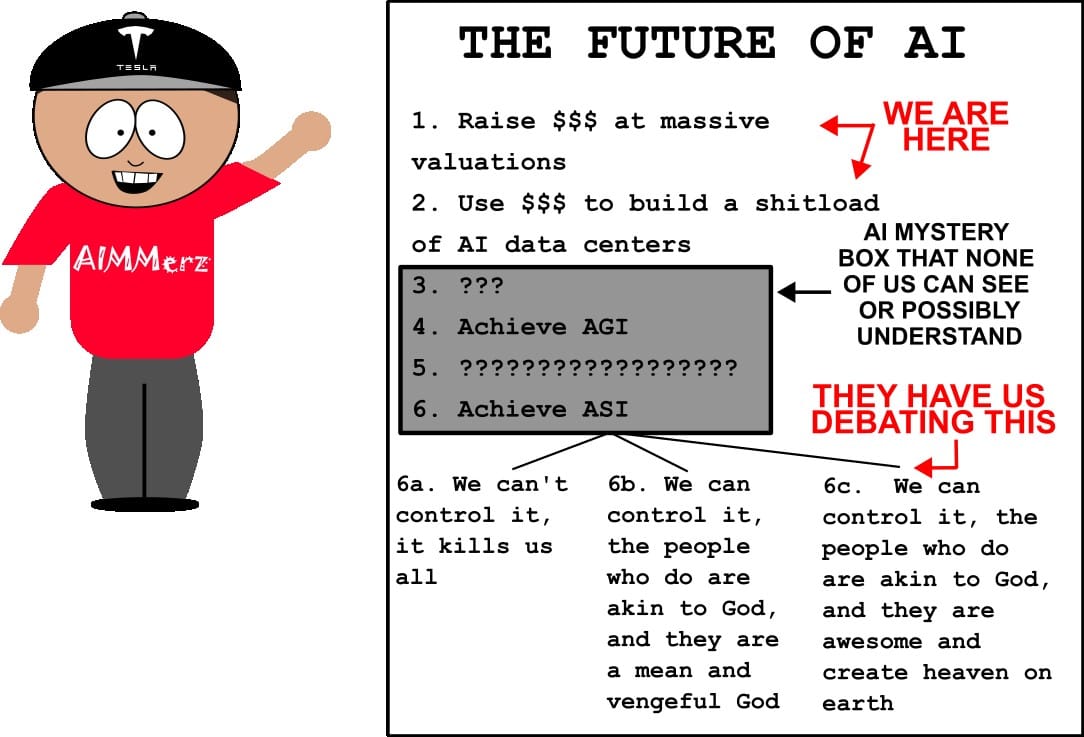
The stated plan is to build something powerful enough to kill us all, but it won’t because AIMMerz and our government will control it and do good things with it. The way we get there is purely theoretical, the specifics of which no one agrees upon. Why is anyone buying into this shit? Because this version of events put those currently in charge on the brink of being masters of the universe, and it justifies everything they’re doing today. Speaking of which…
AI companies consume an incredible amount of natural resources already, and they want a lot more
MIT Technology Review estimates that in 2024, AI-specific servers in data centers in the U.S. consumed enough electricity to power 7.2 million homes for a year. By 2028 this is projected to rise over 400%, enough electricity to power around 31 million homes, roughly one fifth of all homes in the U.S. Initial studies estimate the increased electricity demand will result in significantly higher costs for the average residential power customer.
Data centers consume hundreds of billions of gallons of water in the U.S. each year to cool their servers, 80% of which is evaporated and the rest is returned to wastewater facilities. One large data center can consume as much water in a day as a town of 50,000 people. As data centers continue to proliferate, their strain on the water supply in these regions will grow. The electricity and water demands are very real and imminent, unlike any societal benefits of AI.
AI is a long way from making the world a better place – it’s still working out how to tell the time
AI is already as good or better than humans in many specific areas and it is improving rapidly. AI also cannot reliably tell the time on an analog clock. This is the paradoxical state of AI today. And it is yet to make a meaningful positive impact on our world.
Some examples where AI is providing significant efficiency and accuracy gains are software coding, certain legal tasks, customer support, certain clinical tasks and self-driving vehicles / driver assistance. While this is already providing significant value to certain organizations, its benefits have yet to broadly affect our society in positive ways. AI companies can point to individual examples of success, but it hasn’t made our roads safer, our medical outcomes better, or significantly reduced the cost of living. When AI is obviously present in society today, it is often in annoying or harmful ways: a useless layer of customer service, an AI-generated ad that can’t spell “Coca-Cola” correctly, or an AI chatbot giving extremely bad advice.

This isn’t to say AI isn’t useful or impressive. It is. This is to say that to the extent AI is a positive force today, it is mostly for companies and investors. Its benefit to the rest of us is just a promise AIMMerz have made, and it’s not one I expect to be kept.
We need to stop giving AIMMerz the benefit of the doubt because ‘I don’t understand AI’
It is in the AIMMerz best interest for AI to remain a mysterious black box to the rest of us. Something only they can understand and explain to us. Kind of like how superintelligence will be black box to AIMMerz. Something only superintelligence understands and has to explain to them. And according to AIMMerz superintelligence could kill us all. What could the AIMMerz do?
I’ll guess they get super rich, consume unconscionable amounts of resource and money at the expense of the general public, and give us very little in return. To put it in the words of OpenAI CEO Sam Altman just a week ago: “We believe that the world should accept some bad things happening for the benefits of this technology.”